

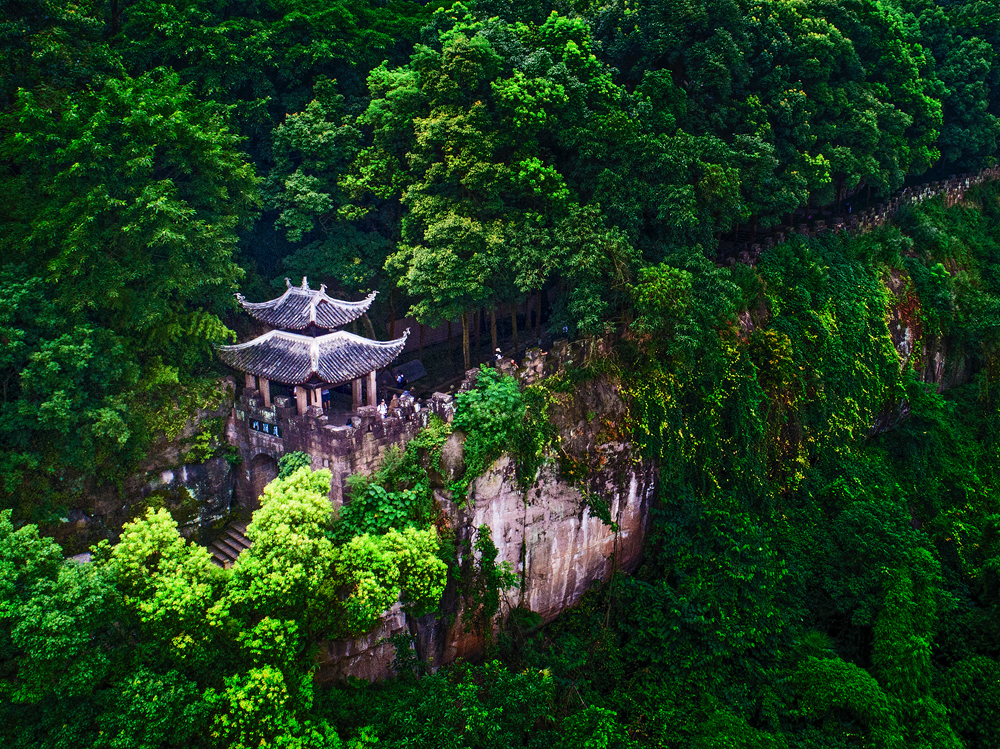
Diao You City is located in Diao You Mountain, Hechuan, Chongqing, controlling the three rivers—Jialing River, Qu River, and Fu River—making it a crucial pass between Ba and Shu since ancient times. In the third year of the Chunyou era (1243) of the Southern Song Dynasty, Yu Jie followed the advice of Ran Jin and Ran Pu to build the city, serving as the core of the mountain city defense system in Sichuan. From 1243 to 1279, under the leadership of Wang Jian and Zhang Jue, the military and civilians of Hezhou defended the city for 36 years against the elite forces of the Mongol Yuan Dynasty using strategies of "fortifying the city, attacking as a defensive measure, and combining farming with warfare." The city withstood over 200 battles, and in 1259, the death of Kublai Khan at the city's walls led to the withdrawal of the Mongol army from the Eurasian battlefield, "extending the Song Dynasty's rule" and mitigating the devastation of the Eurasian wars. It is hailed as "a heroic city that influenced medieval world history." The site now features an 8-kilometer city wall, eight city gates, and remnants of military life from the Southern Song Dynasty, along with scenic spots and inscriptions by historical figures from the Tang to Qing dynasties, making it the best-preserved ancient battlefield site in China.
In the 13th century, the Mongol Empire was a time of global domination. The formidable Mongol cavalry swept across continents, conquering dozens of nations in Europe and Asia and establishing an unprecedented vast empire spanning both continents.
In the autumn of 1258, Khagan Mongke personally led six armies, intending to advance eastward along the Yangtze River via Chongqing and join forces with Kublai Khan and Uriyangkhadai, who were attacking Jingxiang, to annihilate the Song Dynasty in one decisive blow. The century-old showdown between the agrarian and nomadic civilizations of East Asia had reached its final life-and-death juncture. At this moment, a small town destined to become world-famous for him lay quietly blocking his path forward.
Hezhou, situated at the confluence of three rivers, has been a crucial stronghold of Ba-Shu since ancient times, boasting picturesque landscapes, fertile farmlands, and abundant resources. Faced with the rapid advance of the Mongol army, Yu Jie, the Pacification and Military Commander of Sichuan, adopted the proposal of the brothers Ran Lian and Ran Pu from Buzhou, initiating the construction of a military defense system centered around the Diaoyu City. He relocated the administrative and military institutions of prefectures, states, and counties to the mountain cities, stationing troops and stockpiling provisions to safeguard the entire Sichuan region. The towering Diaoyu City, strategically perched at the throat of the three rivers' confluence, occupies a pivotal position with its formidable terrain, blocking all approaches and serving as a vital pillar of Sichuan's mountain city defense system.